Enough for Today

Then the LORD said to Moses, "I will rain down bread from heaven for you. The people are to go out each day and gather enough for that day.” Exodus 16:4
THE SUN IS JUST RISING above the trees, and the air is still cool when I step out my kitchen door. I’m barefoot and the grass is wet and cold. Drops of water hang from the clothesline across the yard like so many miniature garments left out to dry. Mist shrouds the mountain in front of the house. Later today, a summer sun will sit high in the sky, blazing hot, and the moisture will burn away; but for now, warmth comes only from the odd sunbeam and the long sleeves of my work shirt.
I’ve come this morning for the raspberries in the corner patch. It’s heavy with them—pink, red, amethyst, and wine—all at various stages of ripening. The canes bend and arc, and morning dew pools on the leaves, cisterns for bird and beetle alike. As I cross the yard, a mourning dove calls for a mate. There’s a newness to these mornings, as new as if I were walking in Eden itself, fresh and full of hope. I’ve come to collect raspberries for breakfast but more likely I’ve come to collect myself.
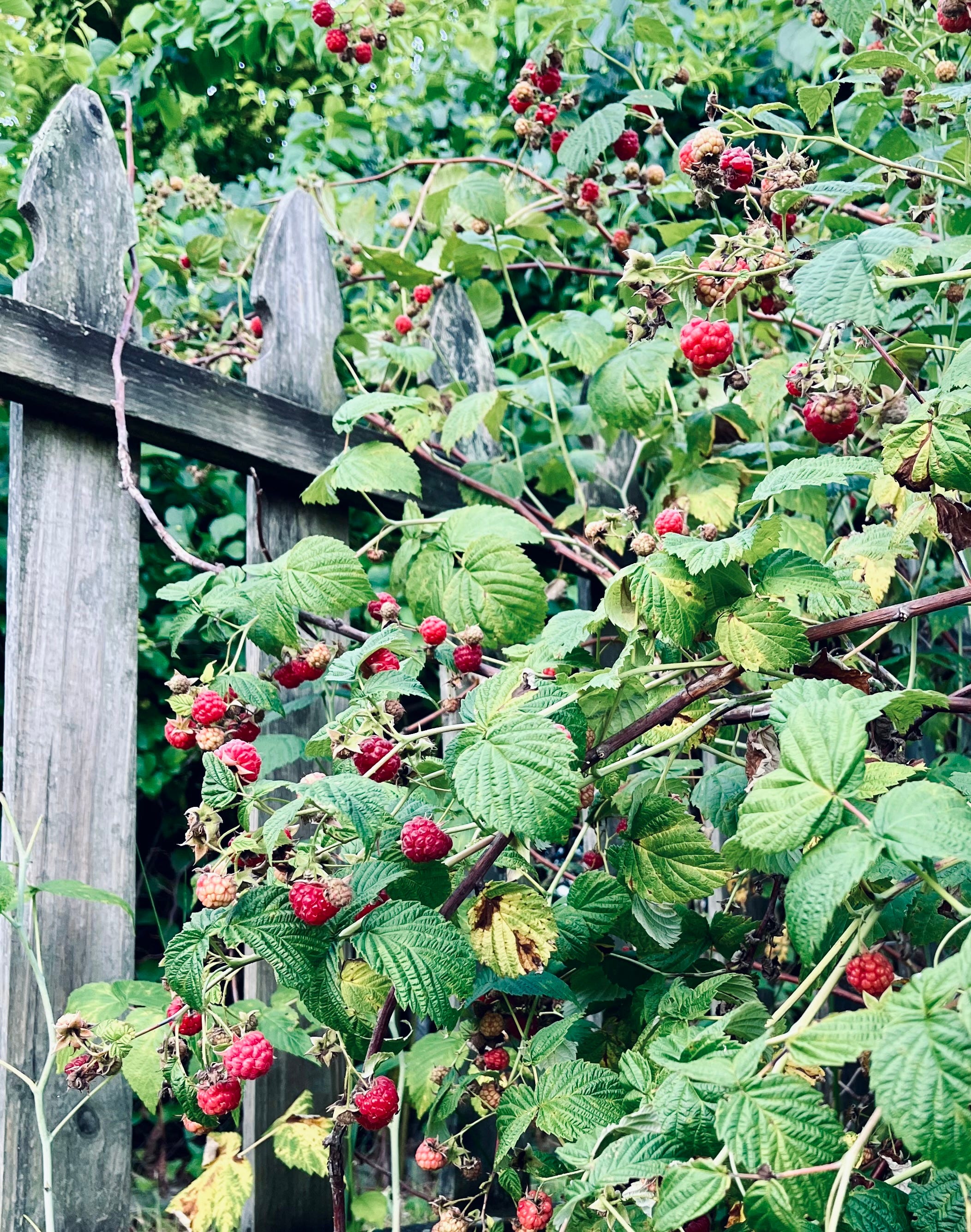
It’s the dew that most makes me think of Eden, how “a mist went up from the earth and watered the whole face of the ground.” Rain is fine for watering, and we’re grateful for it, but the dew settles differently somehow. Quiet, steady, and abundant.
Strictly speaking, dew is the result of moisture that condenses as the temperature drops. This cooling happens most often overnight when the sun takes its warming
rays to the other side of the earth, which is why we will wake up to dew in the morning—at least when the temperature doesn’t drop too far. In late fall and winter, this same moisture might skip the condensation phase entirely and sublimate directly to ice, coating the blades of grass in an exquisite layer of frost. But here on a summer morning, the molecules gather as dew.
By now, I’ve gathered what I need from the thicket, but I find I’m reluctant to leave this moment; this moment when the work of the day is held in check, when I’m not yet asked to produce or perform, when the earth has produced for me. So I wander a bit, over to the garden, past the lilac, toward the apple trees, the cuffs of my pants soaking up dew with each step.
The book of Exodus tells us that the children of Israel ate manna that came with the dew, that God “rained” it down on them in the wilderness. The people would go to bed without the next day’s provision in hand and have to sleep with the hope that it would be there in the morning. I wonder how many of them would lie awake for worry. I would. I do.
Scholars and naturalists wonder whether this dew bread, this “bread of heaven,” might have been a product of the tamarisk tree, a desert shrub that leaks a pale sweet sap that crystallizes. Others suggest that it was the secretions of a small, scale insect that feeds on the tamarisk tree through the night. These small granules resemble the Scriptural description of manna that was “white like coriander seed and tasted like honey” and could be gathered and made into cakes, as they still are across the Middle East today.
Some may balk at this natural explanation, preferring a more immediately miraculous one. But I wonder, is it any less a miracle that God provides through nature? Is it any less a miracle to feed millions with tamarisk than to feed millions with flocks of quail or water from a rock? Is it any less a miracle to feed one with raspberries gathered among the thorns?
Is it any less a miracle that God’s mercies fall like dew every morning? And only in the morning?
Hundreds of years after the manna, a descendent of those desert wanderers writes: “Give me only my daily bread. Otherwise, I may have too much and disown you and say, ‘Who is the Lord?’ Or I may become poor and steal, and so dishonor the name of my God.”
Because here’s the paradox of dew and daily bread and mercies that are new every morning: The manna would fall from heaven on every day except the Sabbath, and the people would gather it. But if they tried to accumulate more than a daily portion, it would corrupt. Try to hoard and store up in your barns and rely on yourself and your smarts and your hard work and your foresight, and you’d be a fool. Sure, you might be a rich fool, but you also might not wake to see the next morning’s dew.
But too little could corrupt just as easily. Because if you didn’t rise to God’s morning provision, if you didn’t get up and go out and gather, you might find yourself starving in the wilderness, tempted to steal. Instead, the children of Israel had to learn to rely on heaven’s daily provision just as surely as the disciples learned to pray, “Give us this day our daily bread. . .”
So too you must awaken each day. You must walk through the dew. You must gather what you have not sown. You must return to Him morning by morning for your daily sustenance. Because make no mistake, it will be provided.
I take a raspberry from my bowl and put it into my mouth. It’s still wet, and I taste the dampness before the sweetness. As I roll it around with my tongue, it separates from itself and cleaves naturally along its drupelets. Gradually, the ruby flesh gives way releasing the life-bearing seed hidden in each one. And I pray, “Give us this day our daily bread, and give us this day our dew and mercies, new. Give us this day our raspberries ripe.”
SCRIPTURE
Genesis 2:6 | Exodus 16:4 | Numbers 11:7–9 | Proverbs 30:8–9 | Lamentations 3:22–23 | Matthew 6:11 | Luke 12:13–21
Excerpted from Turning of Days: Lessons from Nature, Season, and Spirit (Moody Publishers, 2021)